Our method
Our method
How Arcanes calculates the sky, chooses what it says, shuffles the cards and flags its limits. Everything written here matches what the site actually does.
- 341sourced interpretation rules
- 36reading themes
- 28calculated points in the sky
- 10house systems
The sky
Arcanes does its own sky calculations, for every request. Positions come from the Swiss Ephemeris (version 2.10.03) with its complete data files, based on the DE431 ephemerides of NASA's Jet Propulsion Laboratory. The Sun, the Moon, the eight planets, the lunar nodes, Lilith, Chiron, four asteroids, the Part of Fortune, the Vertex and the angles (Ascendant, Midheaven) are calculated, with ten house systems and the sidereal zodiac for those who want it. The Swiss Ephemeris reproduces these ephemerides to a thousandth of an arcsecond. That precision matters: the Moon moves about one degree every two hours. A calculation that is off by one degree shifts the moment the Moon changes sign by two hours, and can change your Moon sign.
Our results are checked by a second calculation, independent of the first: Skyfield, with NASA JPL's DE421 ephemerides. For the Sun, the Moon and the eight planets, the two agree to within a hundredth of a degree. Time is where errors are most common: your local time is converted to Universal Time using the official time zone of your birthplace and daylight saving time as it applied that day, from the international time zone database.
The interpretations
The interpretation does not come from a model making things up. It comes from an engine of written rules, each triggered by a precise configuration of the sky, your numbers or your cards, and each tied to its source: Robert Hand, Liz Greene, Stephen Arroyo, William Lilly, Sakoian and Acker for astrology, Matthew Goodwin for numerology, Jodorowsky and Costa for tarot. When several sources say the same thing on the same day, the Prism shows it.
The text you read is then written by a language model, from these rules only. It knows only what the engine passes on. An automatic check goes over every reading and rejects it if it names a planet or a theme that isn't in those rules, or uses the empty phrases we've banned, such as “the universe” or “energies.” The model then has to start again.
The cards
When you open the table, the cards are already dealt into a pile, face down, in an order drawn by your device's cryptographic generator. Each position in the pile holds a specific card, and each card is already upright or reversed, just like a physical deck.
Each swipe of your finger takes a real chunk of cards off the top and slides it lower down: the final order depends on your gestures. The cut moves the top of the pile to the bottom. When you choose from the fan, the card that comes up is the one that was in that spot: nothing is drawn afterward, nothing is swapped. On devices that can't show the 3D table, the shuffle is done by the same generator, fed by the movements of your finger.
In detail: the starting order and the orientation of each card are drawn with crypto.getRandomValues. On the 3D table, each gesture moves a packet from the pile, and the cut rotates the deck at the chosen point. Without 3D (no WebGL, reduced motion), the order is reshuffled with the Fisher-Yates algorithm, fed by the SHA-256 fingerprint of your gestures. The draw doesn't know your question.
What we don't know
A birth time of “around 2 p.m.” isn't an exact time, and we don't pretend it is. Arcanes works out the precision from the minutes you type (2:30 means to the nearest half hour; 2:25, to the nearest five minutes), then recalculates your chart across that whole window. What stays the same is stated; what shifts is flagged and set aside.
Techniques that astrologers disagree on are flagged as such. And our readings don't predict the future: they describe moods and trends, never events. Here, astrology, numerology and tarot are languages for asking yourself good questions.
Where the Arcanes sign comes from
The gold-ringed disc next to the name isn't a made-up drawing: it's a total solar eclipse, the one on August 12, 2026, which we photographed in Spain. It's what got the project started.
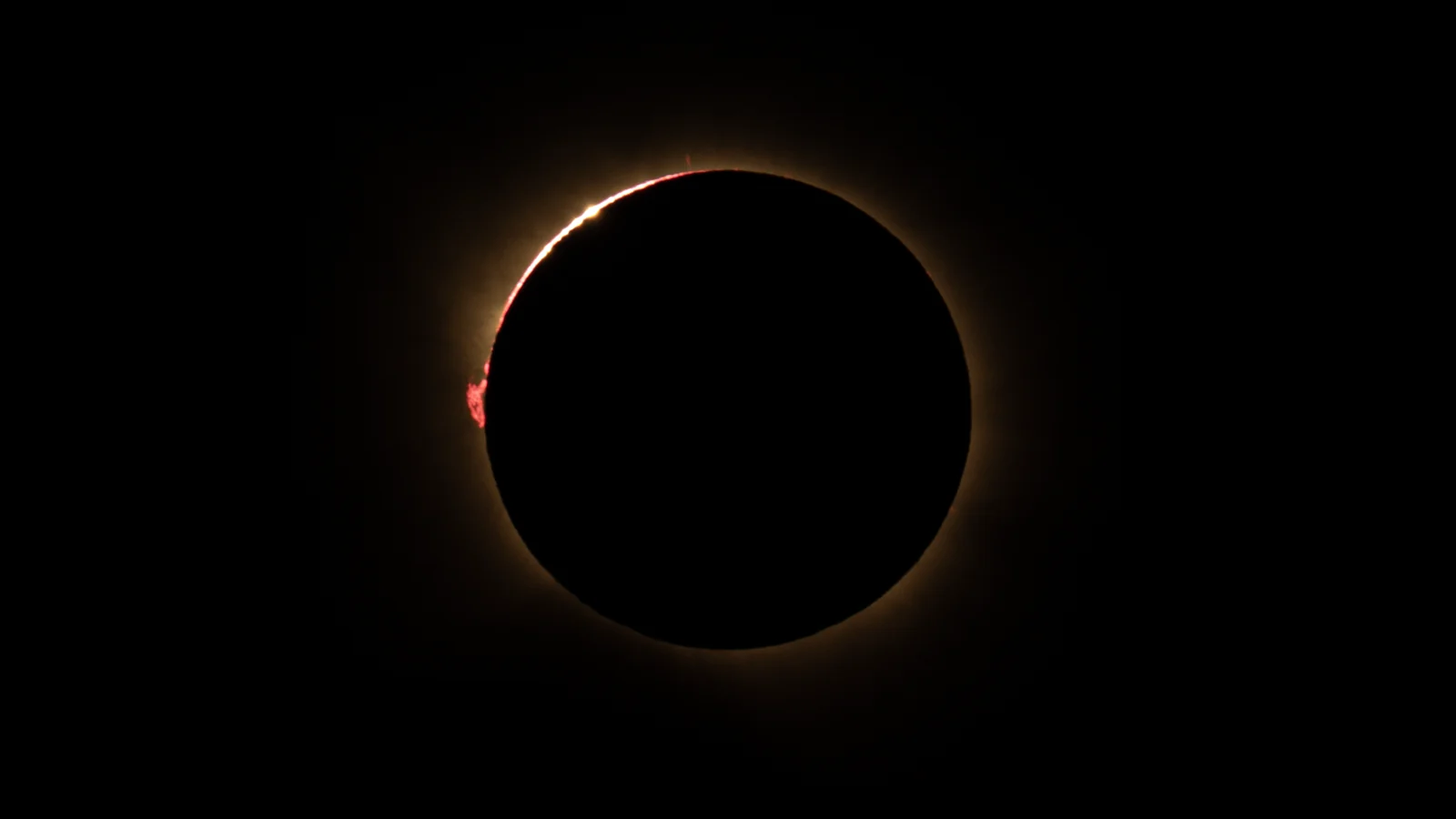
The sign is traced from that photo. The bead of light sits exactly where it was: at 124.5 degrees on the picture, ten to eleven on a clock face. We measured it, like everything else.
Three reading levels
Not everyone comes with the same background. In Discovery, every screen is guided: a box explains what you're looking at and how to read it, and the calculations stay collapsed. It's not less information, it's more explanation. In Initiate, you get the full reading, without the basic reminders. In Expert, everything is shown: dignities, cusps, all aspects, calculation settings. You change level at the top of each page; the calculations themselves don't change.